
In an IoT system for water quality monitoring, sensors are not just measuring devices. They are part of an overall analytical system that determines how water conditions are translated into data. Therefore, the way sensors receive water samples in the field greatly influences the quality, stability, and representativeness of the data produced.
In the field, water quality measurements are not always performed in the same way. There are several approaches to how water is taken or channeled to the sensor before the data is sent continuously and in real-time. These approaches in process analytical chemistry are distinguished based on the position of the analysis relative to the water process itself.
1. In-line / In situ
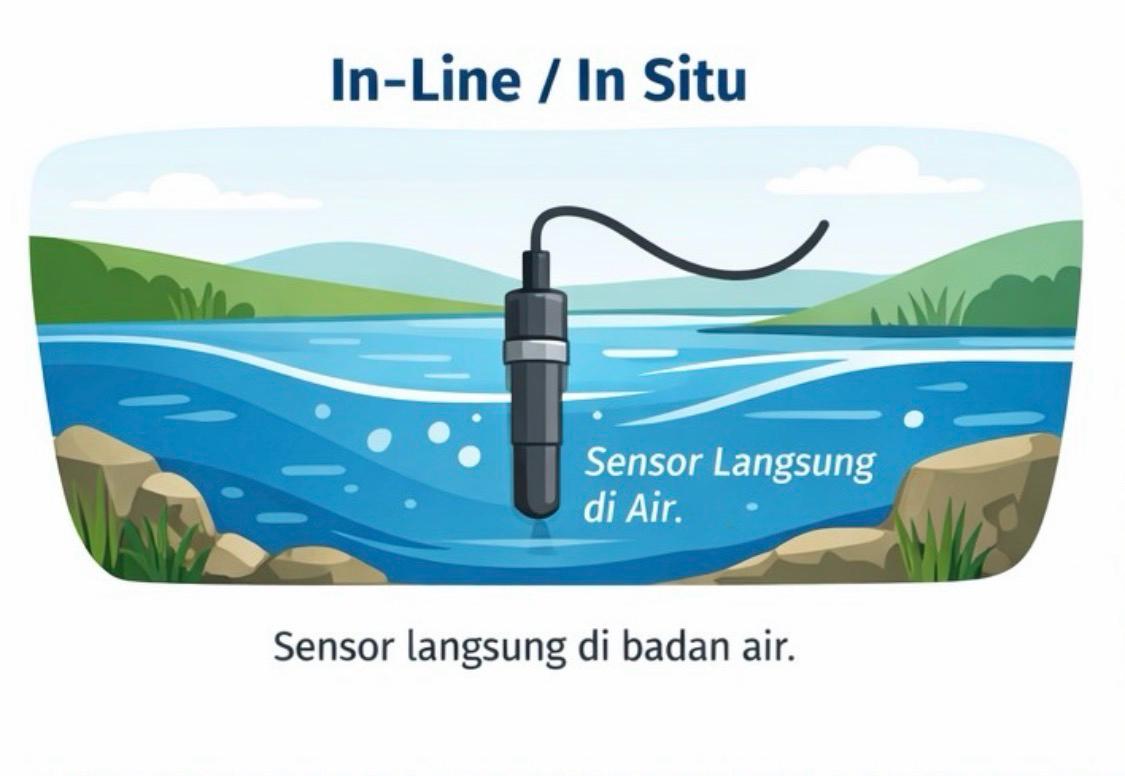
In this method, the sensor is placed directly in the body of water or the main flow. There is no sample collection or transfer process. The sensor reads the water conditions as they are, at that moment. Because the measurement occurs directly in the process medium, this method is considered closest to real conditions.
2. Online monitoring
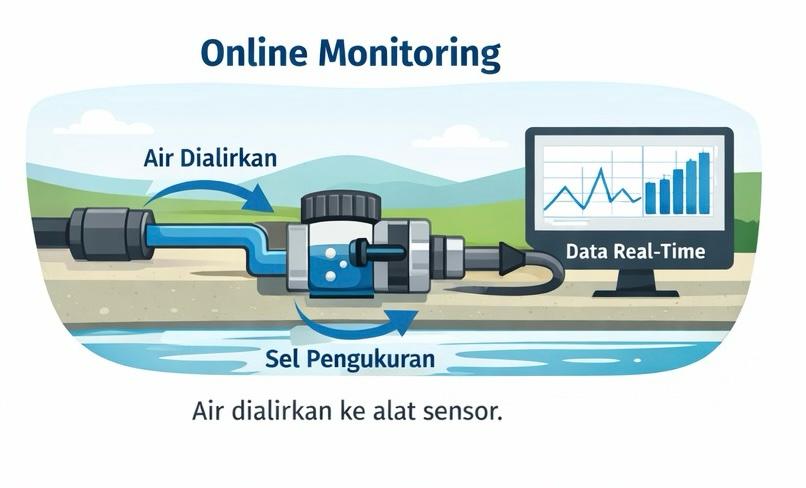
Unlike in situ, in the online method, water is not measured directly in the main flow. Water is first channeled to the sensor through a specific path, such as using a pump or a by-pass channel. This is where the flow-through system is located. Water continuously flows through the measurement cell, then is read by the sensor in real-time. This method remains automatic and continuous, but still involves the process of channeling samples to the measuring device.
3. At-line monitoring
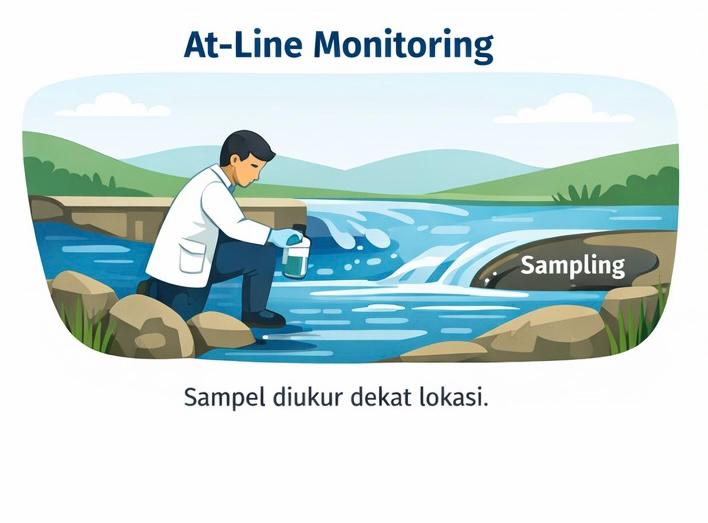
In this approach, water samples are taken from the process and analyzed near the location, but are not directly connected to the main flow. It usually still requires operator intervention, so it is not fully real-time.
4. Off-line monitoring
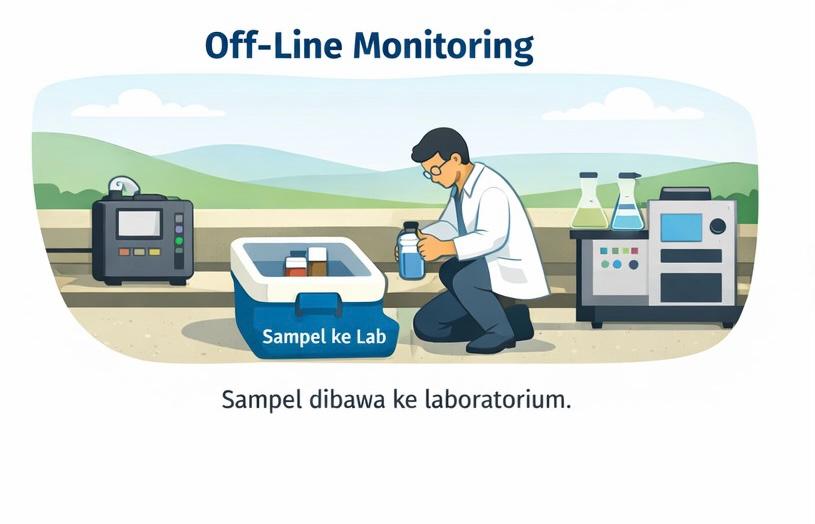
This is the most conventional approach. Water samples are taken from the field and brought to the laboratory for analysis. Accurate for certain analyses, but does not represent real-time conditions due to time delays and potential changes in sample characteristics.
Ultimately, IoT-based water quality monitoring is not just about sensors, networks, or digital dashboards. More than that, it is determined by how the water is treated from the very beginning of the analysis process. Because good real-time data always starts with the design of an appropriate sampling system—even before the first number appears on the screen.
For the right method according to needs, you canContact Us.
Ultimately, IoT-based water quality monitoring is not just about sensors, networks, or digital dashboards. More than that, it is determined by how the water is treated from the very beginning of the analysis process. Because good real-time data always starts with the design of an appropriate sampling system—even before the first number appears on the screen.
For the right method according to needs, you canContact Us.
Source:
Farouk, M. I. H. Z., Jamil, Z., & Abdul Latip, M. F. (2023). Towards online surface water quality monitoring technology: A review. Environmental Research, 238, Article 117147.https://doi.org/10.1016/j.envres.2023.117147
Hossain, S. M. Z., & Mansour, N. (2019). Biosensors for on-line water quality monitoring – a review. Arab Journal of Basic and Applied Sciences, 26(1), 502–518.https://doi.org/10.1080/25765299.2019.1691434
Kumar, M., Khamis, K., Stevens, R., Hannah, D. M., & Bradley, C. (2024). In-situ optical water quality monitoring sensors—applications, challenges, and future opportunities. Frontiers in Water, 6, Article 1380133.https://doi.org/10.3389/frwa.2024.1380133